
Admissions and Aid

Go to Admissions and Aid overview

Get Started

Admissions

Cost and Financial Aid

Academics

Go to Academics overview

Programs and Study

Schools and Colleges

Faculty and Research

Student Experience

Go to Student Experience overview

Campus Life

Student Support

Services and Safety

About

Go to About overview

Overview and History

Leadership and Community

Operations and Policies

Athletics

Go to ubknights.com (opens in a new tab)

Purple Knights

Facilities and Gameday

Join and Support

Alumni

Go to Alumni overview

Alumni Network

Benefits and Services

Support UB / Giving

Highlights from UB’s History

Timeline
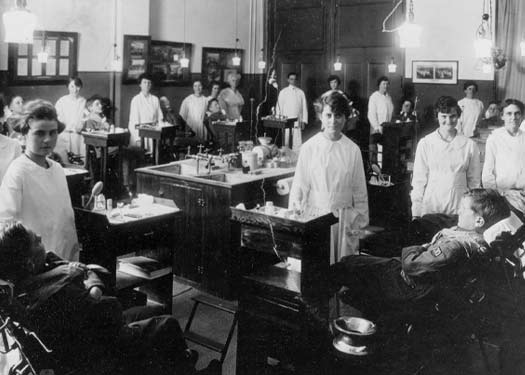
Dr. Alfred Fones establishes the world’s first school of dental hygiene 1913

Dr. Alfred Fones establishes the world’s first school of dental hygiene

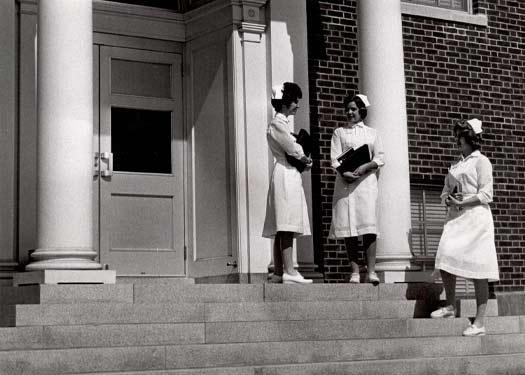
In 1907, Irene Newman first performed the duties of what her cousin, Dr. Alfred Fones, called a “dental hygienist” at their offices on Washington Street in Bridgeport. By 1913, she was instructing the first courses to members of this new profession. Connecticut issued the world’s first license to Newman, and she became the president of the world’s first dental hygiene association. Dr. Fones went on to help found the Junior College of Connecticut, which later became University of Bridgeport. Fones and Newman’s legacy was secured when UB opened the Fones School of Dental Hygiene in 1949. A year later, when asked about her part in this saga, she said, “The work was there to do, and I did it.” Today, graduates of the Fones School continue to achieve national recognition as pioneers in the dental profession.
E. Everett Cortright founds the Northeast’s first junior college 1927

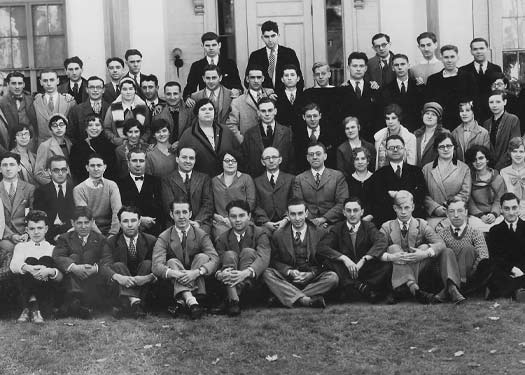
E. Everett Cortright founds the Northeast’s first junior college

In the early twentieth century, Bridgeport was one of the only large U.S. cities with no institution of higher education. Local physics and mathematics teacher E. Everett Cortright believed that equal access to education was necessary for national success, stating, “Ability and leadership must be sought in all groups.” He and two friends, founder of the dental hygiene profession Dr. Alfred Fones and Raybestos president Sumner Simpson, sought to create a two-year junior college, the first in New England. On May 5, 1927, the state charter of the Junior College of Connecticut was signed to resounding local and regional acclaim. With $30,000 of his own money, Fones bought a building on Fairfield Avenue that accommodated three hundred students, who entered the new college to take general education classes, as well as specialties like Hungarian and aeronautics. E. Everett Cortright served as the first president until 1945.

President Cortright buys P.T. Barnum’s Seaside Park property 1939

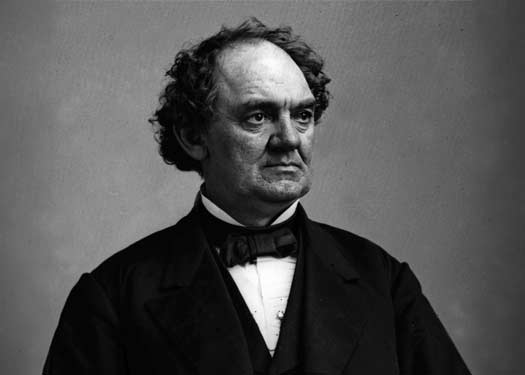
President Cortright buys P.T. Barnum’s Seaside Park property

In the decade after its founding, the Junior College of Connecticut was such a success that a dozen similar colleges appeared throughout the northeast. The school brought in speakers like aeronautics pioneer Igor Sikorsky and Bridgeport mayor Jasper McLevy. Though it struggled during the early years of the Great Depression, it also added technical courses and opened a school of business. Women entered the Junior College of Connecticut with career aspirations, like Mary Birmingham, who “abhorred” housework and signed up in 1933 with plans to become a surgeon. In 1936, the school’s evening division began to include new technical and cultural courses, serving the city’s manufacturing base and immigrant population. In 1939, President Cortright purchased two dormitories and entered negotiations to buy P.T. Barnum’s former Bridgeport estate at the entrance to Seaside Park. Today, first-year students continue to walk through the greatest showman’s gates on the way to their own success.

The Junior College of Connecticut becomes University of Bridgeport 1947

The Junior College of Connecticut becomes University of Bridgeport

At the end of World War II, enrollment at the Junior College of Connecticut exploded, prompting E. Everett Cortright and other leaders to create University of Bridgeport in 1947. After the successful introduction of basketball as a varsity sport, the following year UB added soccer, baseball, swimming, tennis, golf, and football. P.T. Barnum’s Marina Hall became a women’s dormitory, and an army barracks was renamed Fones Hall. But Alfred Fones would earn an even greater legacy when a year later in 1949 the Fones School of Dental Hygiene was founded, completing the long journey from his establishment of the first school of dental hygiene in the world. One of the original school’s lecturers, Dr. Robert Strang, served as UB’s new director, and one of its — and the world’s — first dental hygienists, Mabel McCarthy, gave the invocation to graduates two years later.

Igor Sikorsky fosters UB engineering innovation 1950

Igor Sikorsky fosters UB engineering innovation

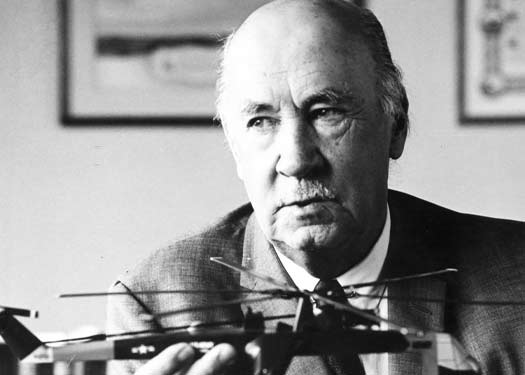
Igor Sikorsky was already an aeronautics pioneer when he arrived in Bridgeport to perfect a new kind of flying machine: the helicopter. In the 1940s, he flew test runs from a Connecticut airfield, piloting the first untethered flight, setting a record for endurance, and creating the world’s first helicopter production line. He began lecturing at the Junior College as early as 1938, and his daughter graduated in 1943. When the newly named University of Bridgeport added a BS in Mechanical Engineering in 1950, he presented students with the gift of a helicopter engine. As the engineering division expanded, Sikorsky gave students research contracts and recruited graduates. The University honored him with a doctorate in 1962, and his spirit of innovation continues today, as UB pioneers fields like artificial intelligence and technology management, maintaining one of the Northeast’s largest engineering programs, with the most ASEE student research awards and near 100% employment rate.

Martin Luther King, Jr. speaks at UB on the American Dream 1961

Martin Luther King, Jr. speaks at UB on the American Dream

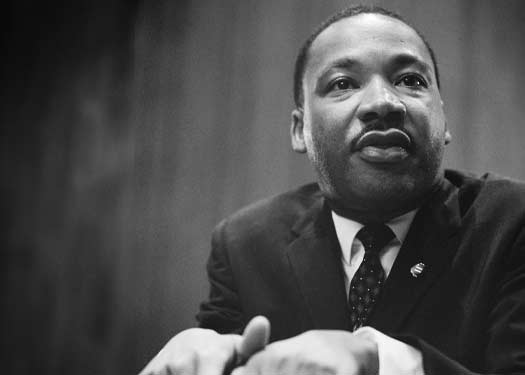
In March of 1961, the Reverend Martin Luther King, Jr. delivered a speech at University of Bridgeport as part of a lecture series on equality that also included Eleanor Roosevelt and Jackie Robinson. More than 2,000 students listened to Dr. King talk about the American Dream in this early version of his most famous speech and lasting legacy. “Brotherhood is our only salvation,” he told the audience. Three #months later, he returned to receive one of his first honorary degrees, and he continued to visit Bridgeport to advocate for the passage of the Civil Rights Act and the rights of all human beings. Today, UB honors his legacy every year with a Day of Service, while majors in human services, criminal justice, and education bring his message of compassion and reform into our lives and our world.

UB football has a perfect season 1972

UB football has a perfect season

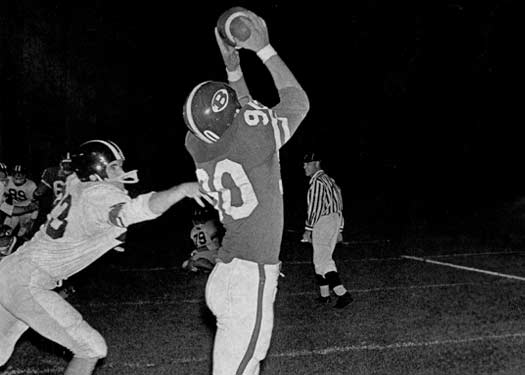
Established in 1948, University of Bridgeport’s football team was boosted by the merger with Arnold College of Physical Education in 1953, sending several alumni to play in the NFL. By the 1970s, the team had become a powerhouse, winning the Knute Rockne Bowl in 1971 and continuing on to an undefeated season in 1972, racking up 21 consecutive wins, the longest winning streak in college football at that time. Their second victory at the Knute Rockne Bowl took place indoors at the huge Convention Hall in Atlantic City. “I remember lying down on the field and looking up at the ceiling of the convention center high above,” recalled footballer David Mosser, “and being lifted up by my teammates in celebration.” The following year, they were ranked 16th in a national poll that included Division I schools, and that perfect 1972 season lived on in the memories of the entire University for decades to come

Manute Bol leads in Purple Knights basketball and education 1984

Manute Bol leads in Purple Knights basketball and education

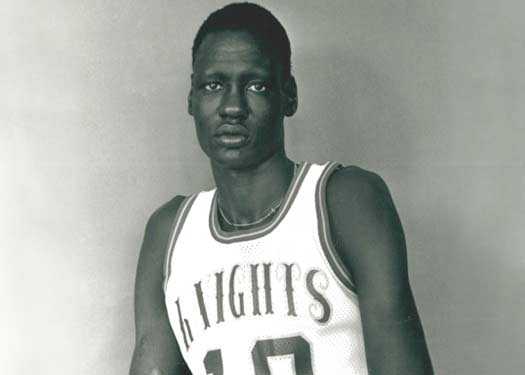
Originally from South Sudan, 7-foot, 7-inch Manute Bol arrived at University of Bridgeport in 1984, leading the Purple Knights basketball team to the NCAA Division II New England Regional Tournament. After a decade playing in the NBA, he returned to his native country to help achieve peace, using his money and fame to try to build schools. “I want every kid to go to school,” he said. “That would be the best thing I did for my people.” Bol passed away in June 2010 from acute kidney failure and complications related to Stevens-Johnson syndrome. His jersey is displayed in the Harvey Hubbell Gymnasium, and his work as an ambassador of peace will continue to inspire every student at UB.

UB institutes America’s first university-based chiropractic program 1991

UB institutes America’s first university-based chiropractic program

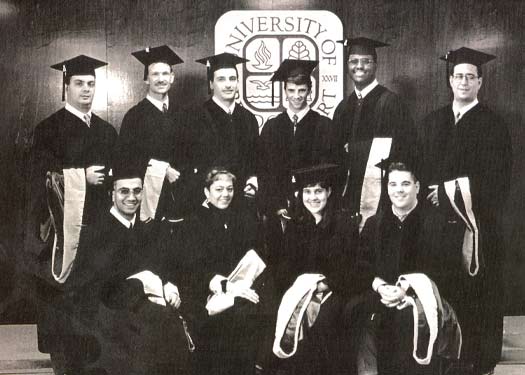
The first master’s degree in nutrition in America had attracted many chiropractors, and as a result, the University began exploring the foundation of a College of Chiropractic. In 1991, UB became not only the first such school in Connecticut, but the only university-affiliated chiropractic school in America. Pioneering chiropractic physician Frank Zolli served as dean, ensuring that from anatomy labs to clinical rotations, the hands-on curriculum was evidence-based, science-driven, and research-centered. Never before had a college achieved accreditation on its initial application to the Council on Chiropractic Education, but in 1994 UB became the first. That year the inaugural class of ten students graduated.

UB gymnastics wins first national title 2009

UB gymnastics wins first national title

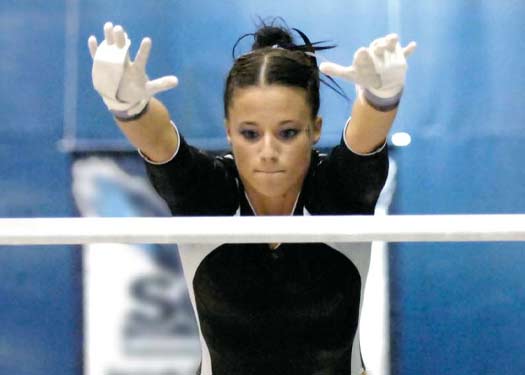
University of Bridgeport sports teams had come close but had never secured a national championship title. In 2009, the women’s gymnastics team changed that when they won the U.S. Gymnastics Collegiate Team National Championships. Five Purple Knights earned All-American honors in individual events, including sophomore Lorraine Galow, who triumphed in the all-around, distinguishing herself as the only Division II gymnast to make a second consecutive trip to the NCAA Division I Regional Championships. “Winning that first national championship helped light a fire under not only our team but the whole University,” said Galow, who later became UB’s coach. “That championship truly proved that perseverance, hard work, and belief in yourself bring success.” The gymnastics team would go on to win five more Collegiate National Championships in the next decade.

Women’s soccer wins NCAA Division II national championship 2018

Women’s soccer wins NCAA Division II national championship

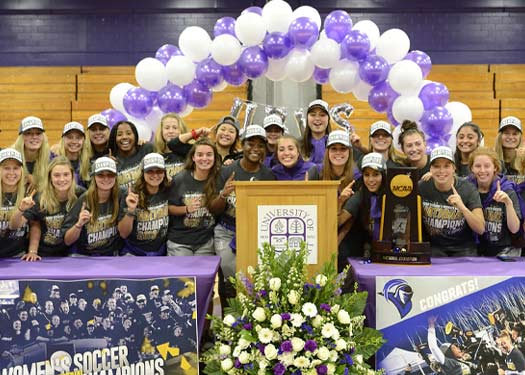
Facing 250 teams, many with much larger student populations and budgets, the UB Women’s soccer team had the odds stacked against them. But on a chilly 2018 day in Pittsburgh, they persevered and won the school’s first NCAA tournament championship. The team of women from six countries included forward Meagan Doyle, who was one of the top scorers in America and was named the 2018 United Soccer Coaches NCAA Division II National Player of the Year. “It’s a fantastic feeling to win a national championship for your alma mater,” said graduate and head coach Magnus Nielrud. “There was an aura about the team that was very relaxed; you could feel something special brewing.”

The History of UB

Read More About UB’s History

Search University of Bridgeport

Find degrees, admissions info, campus directory, and news.