

Research Centers and Labs
MicroN Lab: Microsystem and Nanoelectronics Lab
Where small-scale science powers big ideas
The Microsystem and Nanoelectronics (MicroN) Lab is UB’s interdisciplinary hub for innovation at the micro- and nano-scale. Here, students and faculty collaborate on breakthroughs in microelectromechanical systems (MEMS), nanoelectronics, VLSI design, and cutting-edge applications of artificial intelligence.
Our work spans inertial, optical, biomedical, and RF MEMS — tackling challenges in navigation, healthcare, optical display, and communications. We also explore next-generation nanoelectronics and molecular electronics, advancing Moore’s Law and shaping the future of computing.
Research that reaches the real world
MicroN researchers are pushing boundaries in:
- Molecular electronics: Investigating rotaxane and other molecule-based moletronics for future memory and logic systems.
- AI and machine learning: A primary health care kit is hung near the lab’s entry door. Safety is our top priority. A safety briefing is conducted before starting the lab activity.
- Interdisciplinary discovery: Integrating deep learning with remote sensing to improve environmental monitoring and disaster response.
Hands-on learning and advanced tools
Students gain practical experience with industry-standard hardware and software:
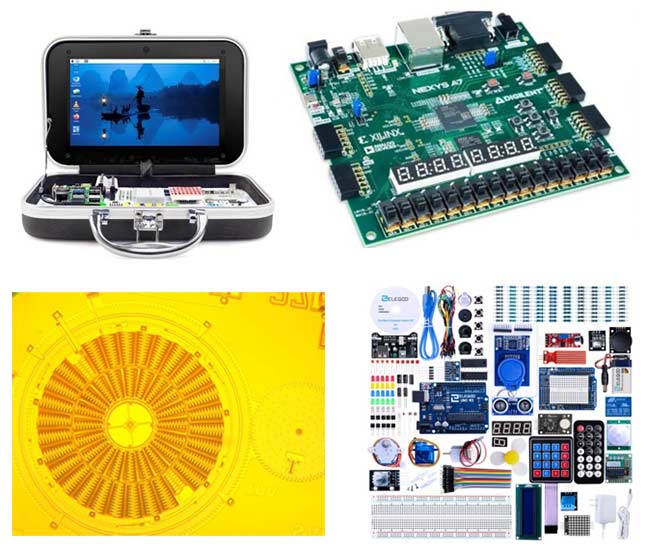
- MEMS Class-on-a-Chip allows students to observe and activate devices in real time
- Raspberry Pi 5, Arduino, and Digilent Nexys A7 FPGA platforms
- Optical microscopes and Altera DE2 FPGA boards
Software and simulation
- COMSOL for MEMS/Bio-MEMS design
- NAMD/VMD for molecular dynamics
- Cadence OrCAD PSPICE, Altera Quartus II/ModelSim, and other VLSI EDA tools
Courses connected to the lab
Tech 213 supports a range of Electrical and Computer Engineering classes, including:
- MEMS (BME/EE-446) and BioMEMS (BME/EE-547)
- Nanotechnology (EE-451)
- VLSI Design, Testing and Low-Power Circuits (EE-448, EE-548, EE-549)
- Microprocessors and Computer Architecture (CPEG/EE-286, CPEG-510)
- FPGA Design, Modern Electronics, and more
Students see theory come alive by designing, simulating, and building devices that prepare them for graduate research or careers in advanced electronics
Recent projects and publications
Rotaxane nanomachines: Peiqiao Wu, Bhushan Dharmadhikari, Prabir Patra, Xingguo Xiong, “Rotaxane Nanomachines in Future Molecular Electronics,” Nanoscale Advances, Royal Society of Chemistry, Vol. 4, June 2022, pp. 3418-3461.
Molecular switches: Peiqiao Wu, Bhushan Dharmadhikari, Prabir Patra, Xingguo Xiong, “Rotaxane as a switch for molecular electronic memory application: A molecular dynamics study,” Journal of Molecular Graphics and Modelling, (Impact Factor: 2.942) Elsevier, Volume 114, July 2022, p. 108163.
AI wildfire detection: “Machine Learning based Wildfire Detection Using Satellite Imagery and Drone Surveillance,” NASA Connecticut Space Grant Consortium (CTSGC) – Faculty Research Grant, PI: Dr. Xingguo Xiong, Co-PIs: Dr. Navarun Gupta, Dr. Ahmed El-Sayed, 07/01/2024 – 05/31/2025.
For more information, contact
Professor Xingguo Xiong, Ph.D.
Department of Electrical Engineering